You Can't Measure a Market Top. You Can Measure How People Talk Near One.
A 10-marker scorecard for late-cycle language in sponsor decks. Score any deal in five minutes, then decide how hard the real diligence needs to push.
Tuesday, August 4, 2026. The S&P 500 closed above 7,700 for the first time. What got my attention wasn't the number. It was the arguments people made about the number.
One strategist offered — as a bullish point — that there's no wall of worry left, that all the money is in, that everyone's invested. Another took the trend line, stretched it forward, and landed on 8,100 by year-end. A third pointed out that the shorts had finally been cleared out when a hedge fund got forced to cover.
None of that is a prediction that stocks fall. I'm not making one either. But if you've been around markets a while, reading those quotes gives you a feeling. Most of us treat that feeling as a vibe and move on. Vibes don't protect capital. A scorecard might.
The professionals already measure this
The idea that you can score how people talk near a top isn't mine. Wall Street has been doing it for decades.
Citigroup runs a Panic/Euphoria model built from things like margin debt, options activity, fund flows, and newsletter sentiment. Bank of America surveys fund managers every month, and when their cash levels drop below about 4%, it treats that as a sell signal — everyone who was going to buy already has. There's also good evidence that the share of household wealth sitting in stocks predicts the next decade of returns better than almost anything else: the more everyone owns, the worse the road ahead.
Fair warning, though: Citi's model flashed euphoria well before the dot-com top, and the Nasdaq more than doubled after it first did. These readings are terrible timing tools. What they actually tell you is simpler and still valuable: when the gauge is pinned, returns from here have historically been poor, and staying disciplined is about to feel expensive and look stupid. That's all they tell you. That's enough.
Your inbox is a sentiment index too
Here's the part I haven't seen anyone else say out loud.
Public markets argue with you every day. If you buy a stock on a euphoric story, the price will tell you tomorrow, and the day after, whether the story is holding up. It's annoying, but it's a service.
Private deals don't argue with you. When the euphoria is in a sponsor's deck, it gets locked in the day you wire. There's no daily mark to talk you out of it, and the lockup means you live with that vintage for years. You don't find out what that euphoria cost you until much later — when the rosy assumptions finally get tested, and the news arrives as a paused distribution, or a letter that opens with "challenging rate environment" and ends with a capital call.
A lot of us don't have to imagine this. The 2021 vintage of floating-rate bridge-debt multifamily deals was underwritten at peak language: rents only go up, we'll refinance in 24 months. Those decks weren't lies. They were written by people breathing the same air as everyone else in 2021. The problem is that LPs breathed it too, and nobody was keeping score.
And the timing isn't a coincidence. When public markets get expensive — the CAPE ratio is around 42 right now — its second-highest reading on record, behind only the 1999 dot-com peak — and stocks are priced to earn barely more than Treasuries — money floods into alternatives looking for yield. That's exactly when sponsors can raise capital on their weakest underwriting, because the checks show up either way. Euphoric vintages tend to be bad vintages, and unlike a stock, you can't sell out of yours.
The scorecard
So here's what I do now. Every deck that lands in my inbox gets run through ten markers before I get anywhere near a wire. Each one gets scored:
- 0 the marker doesn't show up in the deck
- 1 it shows up, but the deal would still work without it
- 2 the returns depend on it; take it away and the pitch falls apart
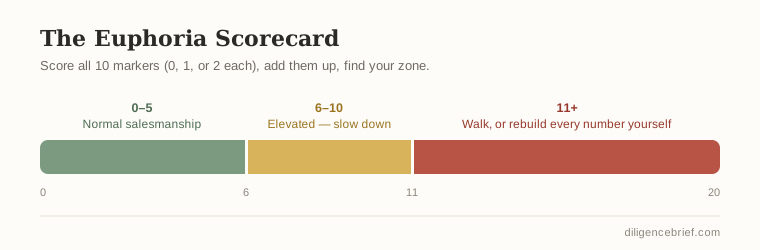
The ten markers are in the sidebar below. The total tells me how to behave:
- 0–5 normal salesmanship. Every deck is selling something. Fine.
- 6–10 elevated. Slow down. Underwrite everything twice.
- 11+ walk — unless I'm willing to independently rebuild every number in the deal myself.
Let me walk a composite through a few markers — this is a blend of real decks I've seen, not any one sponsor. A development deal comes in projecting 8% annual rent growth because the submarket did 8% last year. That's marker 1, and since the whole return depends on it, it scores a 2. The deck shows one IRR, no downside case, no sensitivity table — marker 6, another 2. And the deadline to commit is three weeks before the stated close date, with a note that allocations are filling fast. Marker 5, at least a 1. That's five points from three markers, and I haven't even gotten to the fee section yet.
Notice what the scorecard doesn't require. I don't have to decide whether the sponsor is wrong about rents. I don't have to have a view on rates. I just have to notice what the pitch is leaning on, and count.
What the score actually buys you
Not a crystal ball. I'd call it a discipline subsidy.
When my inbox is scoring high, I don't predict anything. I just change my behavior in ways that are cheap if I'm wrong and valuable if I'm right. I wait longer. I demand a bigger margin of safety. I underwrite the boring case — flat rents, flat commodity prices, no refinance rescue — and treat the upside as a free bonus rather than the plan. And I flatly refuse manufactured deadlines, because a good deal at a real price will survive me taking two more weeks.
If the market keeps ripping, I miss a little upside on a few deals. I can live with that. What I can't live with is discovering, three years into a lockup, that I signed at the top on numbers that only worked at the top.
Because that's the real point. The goal was never to predict the top — nobody can, and the people who claim they can are usually scoring a 2 on marker 1. The goal is to make sure that the deals I sign near a top were underwritten as if it were one.
The 10-Marker Euphoria Scorecard
Score each marker 0 (doesn't show up), 1 (shows up, but the deal works without it), or 2 (the returns depend on it).
| # | Marker | What it sounds like |
|---|---|---|
| 1 | Trend-stretched targets with no valuation support | "8,100 by year-end"; "rents grew 8%, so we model 8%" |
| 2 | Everyone's-already-in framing pitched as bullish | "All the money's in"; "cash coming off the sidelines" |
| 3 | The bear case has been retired | "The shorts have capitulated"; the risks section is boilerplate |
| 4 | This-time-is-different stories | "AI changes everything"; "unprecedented demand" as the return driver |
| 5 | Manufactured urgency | Commit deadline well before the stated close; "allocations filling fast" |
| 6 | One-scenario economics | A single IRR, no downside case, no sensitivity table |
| 7 | Return claims that don't add up internally | Advertised multiple doesn't match what the distributions imply |
| 8 | "Recession-proof" or "uncorrelated" claims | Asserted, never shown through a full cycle |
| 9 | Track record with the losers cropped out | Only realized winners shown; current-fund marks nowhere to be found |
| 10 | Fees hiding behind the growth story | Gross returns in the headline; net-to-LP takes spelunking |
Print the scorecard — The one-page euphoria scorecard, formatted for letter paper. Keep it next to your inbox.
Related: Civilization Got the Returns. The Investors Got the Bankruptcies. and The Bear Case for Stocks Is a Sales Pitch in Your Inbox
This scorecard is one of many checks I run automatically on every deal I consider — not the whole diligence process. It isn't investment advice, and nothing here is a recommendation to buy or sell anything. Do your own homework — that's kind of the whole point.
Tim is an LP in real estate and alternative credit and builds DiligenceBrief, a due diligence tool for LPs.